
Last checked: August 3, 2026. Restaurant service methods, self-service policies, side-dish refill rules, ordering systems and payment procedures can vary by restaurant and change over time. Follow the current signs, equipment and staff instructions at the restaurant you actually visit.
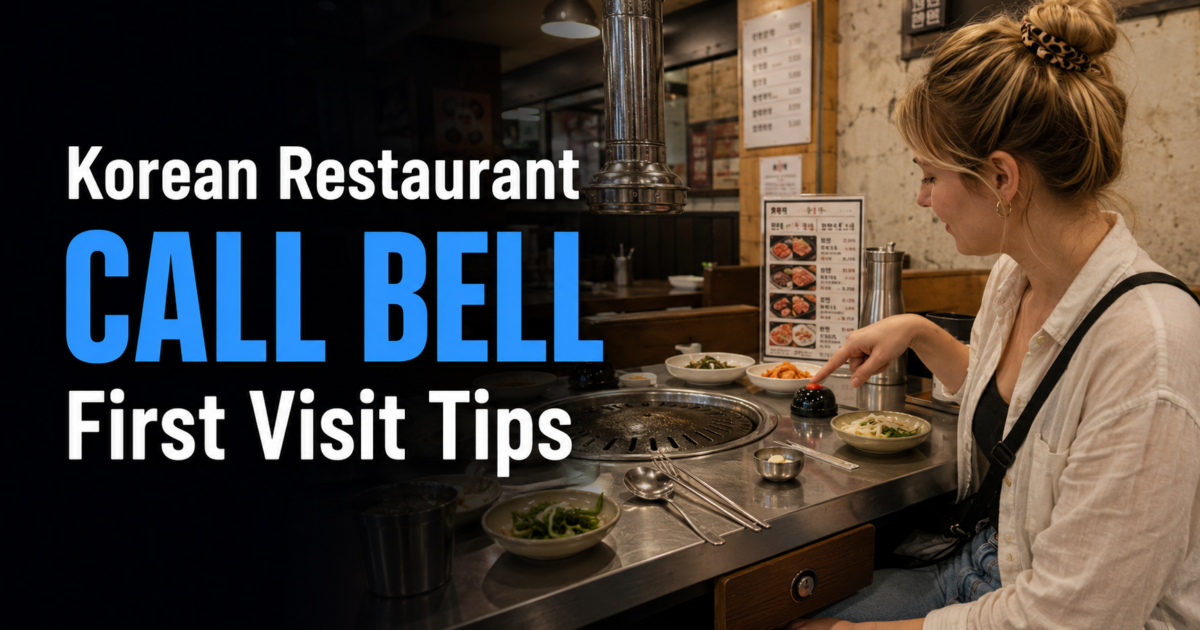
In many casual Korean restaurants, pressing a table call bell once is a normal way to ask a staff member for help. It is not rude when the restaurant provides the button for customers.
The system is not universal. Some restaurants use counter ordering, kiosks, QR menus, table tablets, self-service stations or direct staff service instead. Before pressing the bell, look at how the restaurant expects customers to order and request additional items.
Quick answer: If a Korean restaurant provides a table call bell, press it once when you need staff assistance, prepare your request before they arrive and wait rather than pressing repeatedly. Check for a self-service station or digital ordering screen first, and if there is no bell, make eye contact, raise your hand slightly or say 여기요 or 저기요 in a clear voice.
What Is a Korean Restaurant Call Bell?

A restaurant call bell is a small button that alerts staff that a table needs assistance. It may sit near the edge of the table, beside a napkin holder or as part of a table-ordering device.
VISITKOREA’s guide to Korean food and restaurant service includes call bells among the restaurant features travelers may encounter. It also notes that the bell can sound louder than expected.
Do not treat that description as a rule for every restaurant. Small restaurants, cafés, food stalls, fine-dining venues, counter-service businesses and digitally operated restaurants may use completely different service methods.
Why Service May Feel Quieter Than Expected
Travelers who are used to frequent server check-ins may initially wonder whether they are being ignored. At a restaurant that uses call bells, staff may instead expect customers to signal when they are ready to order or need assistance.
Before waiting or calling someone, check whether the restaurant expects you to:
- press the table call bell
- order on a table tablet
- scan a QR code
- order at the counter
- use a kiosk
- get water or basic items from a self-service station
- wait for a server to approach
If the entire ordering process feels unfamiliar, our guide to how to order food in Korea without speaking Korean explains staff ordering, pointing, translation tools, kiosks and other common methods.
When Should You Press the Call Bell?
Use the bell when you actually need a staff member and the restaurant has not provided another method for that request.
| Situation | Check First | What to Do |
|---|---|---|
| Ready to order | Look for a tablet, QR menu, kiosk or counter-order sign. | Press once after everyone has chosen when staff ordering is used. |
| Need water | Check for a water dispenser or a 셀프 sign. | Call staff when no customer self-service option is provided. |
| Need more side dishes | Look for a refill station and check whether the specific item is included. | Ask for the exact side dish rather than assuming every refill is free. |
| Need utensils or napkins | Check beside or under the table for a drawer. | Call staff when the items are not available. |
| Grill or burner problem | Do not dismantle or adjust unfamiliar equipment. | Call staff promptly and show them the problem. |
| Ready to pay | Check whether customers pay at the counter, kiosk, tablet or table. | Call staff only if the payment method remains unclear. |
Press Once and Prepare Your Request

One press is normally enough to signal the table. Some systems already display the table number to staff even when nobody reaches you immediately.
Before pressing, decide what you need. A short, specific request is easier for both you and the staff than calling someone over while the group is still choosing food.
- Check whether the request is handled through a self-service area or ordering device.
- Choose the menu item or identify the problem.
- Press the bell once.
- Wait for staff to arrive.
- Point to the menu, empty dish, grill or screen when useful.
- Confirm the quantity before the staff member leaves.
If nobody responds after a reasonable period, make eye contact, raise your hand slightly or say 저기요. Avoid pressing the button several times within a few seconds because the system may already have sent the alert.
Check for Self-Service Before Calling Staff
Some restaurants provide customer self-service areas for water, utensils, napkins, sauces or basic side dishes. Look for a station near the counter or a sign marked 셀프, meaning self-service.
VISITKOREA also notes that self-service water and side dishes have become common at some restaurants. Follow the actual signs at the location rather than assuming that every restaurant uses the same system.
Use only items that are clearly provided for customers. Do not enter a staff-only preparation area or assume that every container near the counter is part of the self-service station.
Basic banchan may be refillable at many ordinary restaurants, but restaurant policies differ. Rice, noodles, meat, cheese, drinks, premium ingredients and other menu items may cost extra. When you are unsure, ask about the specific item before taking or ordering more.
Call Staff for Grill and Burner Problems
At Korean barbecue, hot-pot and stew restaurants, the table may contain a grill, charcoal, gas burner, induction plate or boiling pot. Staff involvement differs by restaurant.
Use the call bell when:
- the grill plate needs attention
- there is excessive smoke
- the flame or heat appears unsafe
- the charcoal needs attention
- you do not understand the burner controls
- a hot pot is boiling over
Do not move charcoal, dismantle a burner or handle unfamiliar hot equipment without guidance. Some Korean BBQ restaurants expect customers to grill the meat, while others have staff cook part or all of it.
If you are eating barbecue alone, our solo Korean BBQ guide explains minimum orders, one-person seating, grill service and easier alternatives when a regular barbecue table is not practical.
What If There Is No Call Bell?
First check whether the restaurant uses a tablet, QR menu, kiosk or counter ordering. A missing bell may simply mean that service is handled another way.
When staff ordering is used and there is no bell, make eye contact, raise your hand slightly and use a short expression in a clear, moderate voice.
| Korean | Romanization | Meaning |
|---|---|---|
| 여기요. | Yeogiyo. | Excuse me / Over here. |
| 저기요. | Jeogiyo. | Excuse me. |
| 주문할게요. | Jumunhalgeyo. | We would like to order. |
| 도와주세요. | Dowajuseyo. | Please help us. |
VISITKOREA also gives Yeogiyo as an example of how to call staff when you need to order more or ask a question. You do not need to shout across the room; a clear voice and a small hand gesture are usually enough.
Useful Phrases After Pressing the Bell
| Korean | Romanization | Meaning |
|---|---|---|
| 이거 하나 주세요. | Igeo hana juseyo. | One of this, please. |
| 이거 두 개 주세요. | Igeo du gae juseyo. | Two of this, please. |
| 물 좀 주세요. | Mul jom juseyo. | Water, please. |
| 반찬 좀 더 주세요. | Banchan jom deo juseyo. | More side dishes, please. |
| 불판 좀 갈아 주세요. | Bulpan jom gara juseyo. | Please change the grill plate. |
| 계산 어디서 해요? | Gyesan eodiseo haeyo? | Where do I pay? |
| 감사합니다. | Gamsahamnida. | Thank you. |
Showing the written Korean phrase on your phone while pointing to the relevant menu item or object can be easier for staff to understand than relying only on romanized pronunciation.
What If the Table Uses a Tablet or QR Menu?
Some restaurants use a table tablet or QR page for orders and additional requests. In that situation, a physical bell may be intended mainly for problems the digital system cannot handle.
Before calling staff, check whether the screen already provides options for:
- additional orders
- water or side-dish requests
- staff assistance
- payment
- order history
If the digital system does not work, requires information you cannot provide or leaves you unsure whether the order was received, show the exact screen to staff.
For the full process, see our guide to what to do when a Korean restaurant has only a QR code menu.
How Payment Works
Do not assume that pressing the call bell automatically brings a bill or card terminal to the table. Payment procedures vary by restaurant.
- Counter payment: Finish the meal and pay near the entrance or cashier.
- Prepayment: Pay at a kiosk or counter before the food is served.
- Table payment: Staff bring a card terminal or process payment at the table.
- Digital payment: Complete payment through a tablet or QR ordering system.
Watch the restaurant’s signs and equipment or ask staff when the payment location is unclear. The useful phrase 계산 어디서 해요? means “Where do I pay?”
Tipping is generally not required or expected at ordinary Korean restaurants. The VISITKOREA restaurant guide also states that tipping is not required at Korean restaurants.
If you want the broader rules for restaurants, cafés, taxis, hotels and service charges, our tipping in Korea guide explains when no tip is expected and why an optional gratuity is different from a stated service charge.
Common Mistakes to Avoid
- Waiting silently when the restaurant clearly provides a call bell for staff service.
- Pressing the bell repeatedly within a few seconds.
- Calling staff before the group has decided what to order.
- Ignoring a clearly marked self-service station.
- Assuming every side dish or additional menu item is free.
- Trying to adjust unfamiliar charcoal or burner equipment alone.
- Using the bell for an order that the restaurant clearly expects through a tablet or QR system.
- Assuming every restaurant brings the bill to the table.
- Using a loud or irritated tone after pressing the bell.
- Assuming every Korean restaurant follows the same service system.
Frequently Asked Questions
Is it rude to press a Korean restaurant call bell?
No, not when the restaurant provides it for customer use. Press it once, wait and make a clear request when staff arrive.
Should I press the call bell more than once?
Start with one press. If nobody responds after a reasonable period, make eye contact, raise your hand or say 저기요. Press again only when necessary rather than repeatedly pressing within a short time.
Should I use the bell for water or side dishes?
Check for a self-service station first. When no customer station is provided, use the bell and ask for the specific item. Do not assume that every additional item is included without charge.
What should I do if there is no call bell?
Check for a tablet, QR menu, kiosk or counter-ordering instruction. When staff ordering is used, make eye contact, raise your hand slightly and say 여기요 or 저기요.
Do I press the bell to pay?
It depends on the restaurant. Some businesses use counter payment, while others use prepayment, table payment or a digital system. Check the setup before calling staff specifically for the bill.
Do all Korean restaurants have call bells?
No. Call bells are a service feature found at many restaurants, but they are not universal. Follow the signs, ordering system and equipment at the restaurant you actually visit.
Final Takeaway
A Korean restaurant call bell is simply a service tool when the restaurant provides one. You do not need to feel awkward about pressing it, but you also should not assume that every restaurant expects you to use one.
Press once, prepare a short request, check for self-service first and confirm whether ordering and payment are handled by staff, a counter, a tablet or a QR menu. For grill or burner problems, call staff rather than experimenting with unfamiliar hot equipment.
Call-bell use, self-service rules, side-dish refills, digital ordering, grill service and payment methods vary by restaurant. The most reliable rule is to follow the current setup and instructions at the place in front of you.